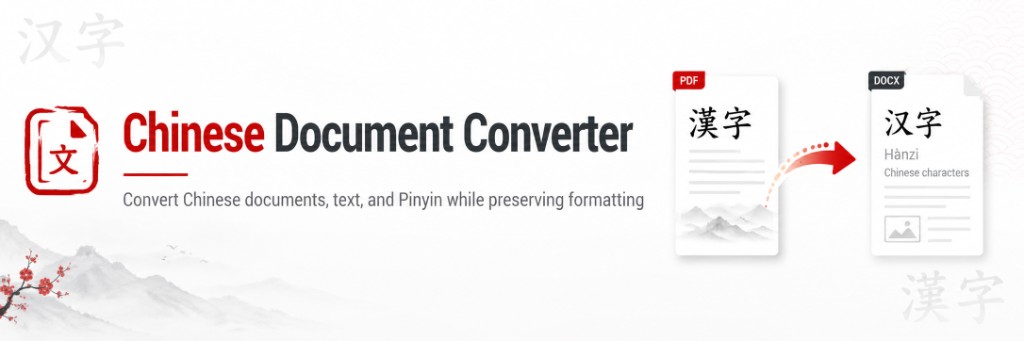
Simplified and Traditional Chinese are two ways of writing the same language family. They share history and many characters, but they are not interchangeable in every classroom, courtroom or app store. Taiwan, Hong Kong, Macau and many overseas communities still use Traditional characters. Mainland China and Singapore use Simplified characters. A reader of one system can often parse a good deal of the other. A publisher still has to pick one.
This section explains the writing systems, the regional variants, and the practical work of converting characters with OpenCC. It does not teach you to translate a document into another language. Conversion changes 门 to 門. Translation would decide whether a sentence should say "door," "gate," or something else entirely.
If you arrived from the homepage converter, start with Simplified vs Traditional Chinese so the dropdown labels mean something, then come back here for the job you actually have.
What conversion is
A converter is a dictionary engine. It walks through text, matches characters and sometimes multi-character phrases, and writes the target standard. ChineseDocConverter uses OpenCC for that work in the text converter and the document converter.
Conversion is the right tool when the language is already Chinese and only the written standard should change. It is the wrong tool when the reader does not read Chinese, or when a text must be rewritten for a new city's laws and jokes. Conversion vs translation draws that line with examples.
Because some Simplified characters stand for more than one Traditional character, conversion is also not a safe archive format. Keep the original file. One-to-many mappings explains the mergers that cause the usual surprises.
Choose a conversion standard
OpenCC, the library behind this site, supports more than one Traditional target. Taiwan and Hong Kong do not always use the same character or the same vocabulary. "Traditional Chinese" in a language menu is a family name, not a finished specification.
- Read Taiwan vs Hong Kong Traditional Chinese if you know the file will be read in one of those places.
- Read OpenCC conversion types for a table of every option in the dropdown, including phrase tables and Traditional-to-Traditional normalization.
- Use Simplified to Traditional or Traditional to Simplified when you already know the direction and need a working sequence.
Phrase options add some regional wording on top of character changes. They are still not a human localizer. If the document is a contract or a brand campaign, budget for an editor in the target region.
After you convert
Character conversion can be one-to-many. One Simplified character may map to several Traditional forms. Names, menus, slide titles and spreadsheet cells are where the dictionary has the least context.
That is why a pass of proofreading still matters, especially in names, legal text and published books. Common conversion problems collects the other frequent failures: mojibake, mixed Japanese, overflowed slides, and leftover characters in headers.
When you are ready to convert a paragraph, use the text converter. For a whole file, use the document converter. If you needed pronunciation spellings instead of a new character set, that is a different section: Pinyin.